Cold Plasma
Cold Plasma, Atmospheric Plasma, or Atmospheric-Pressure Plasma (Cold Atmospheric Plasma, CAP) is a partially ionized gas generated under normal ambient conditions. As the fourth state of matter, it primarily contains electrically charged particles such as electrons, as well as reactive oxygen species (Reactive Oxygen Species, ROS). Unlike industrial low-pressure plasma processes, atmospheric plasma does not require a vacuum chamber, making its use outside laboratories and manufacturing facilities possible.
Generation at Atmospheric Pressure.
The adjective “atmospheric” describes the operating pressure of the plasma system. Throughout the generation process, the gas remains at a pressure level corresponding to that of the surrounding air. High-frequency electric fields are used to excite the gas, converting ambient air or noble gases into the plasma state. Common configurations include dielectric barrier discharge (DBD), corona discharge, and plasma jets.
Since no pressure vessel is required, atmospheric-pressure plasma devices can be designed in a compact form. In DBD and plasma-jet configurations, ambient air can serve as the process gas, eliminating the need for dedicated gas connections. This enables mobile use, for example at the patient’s bedside or in outpatient care.
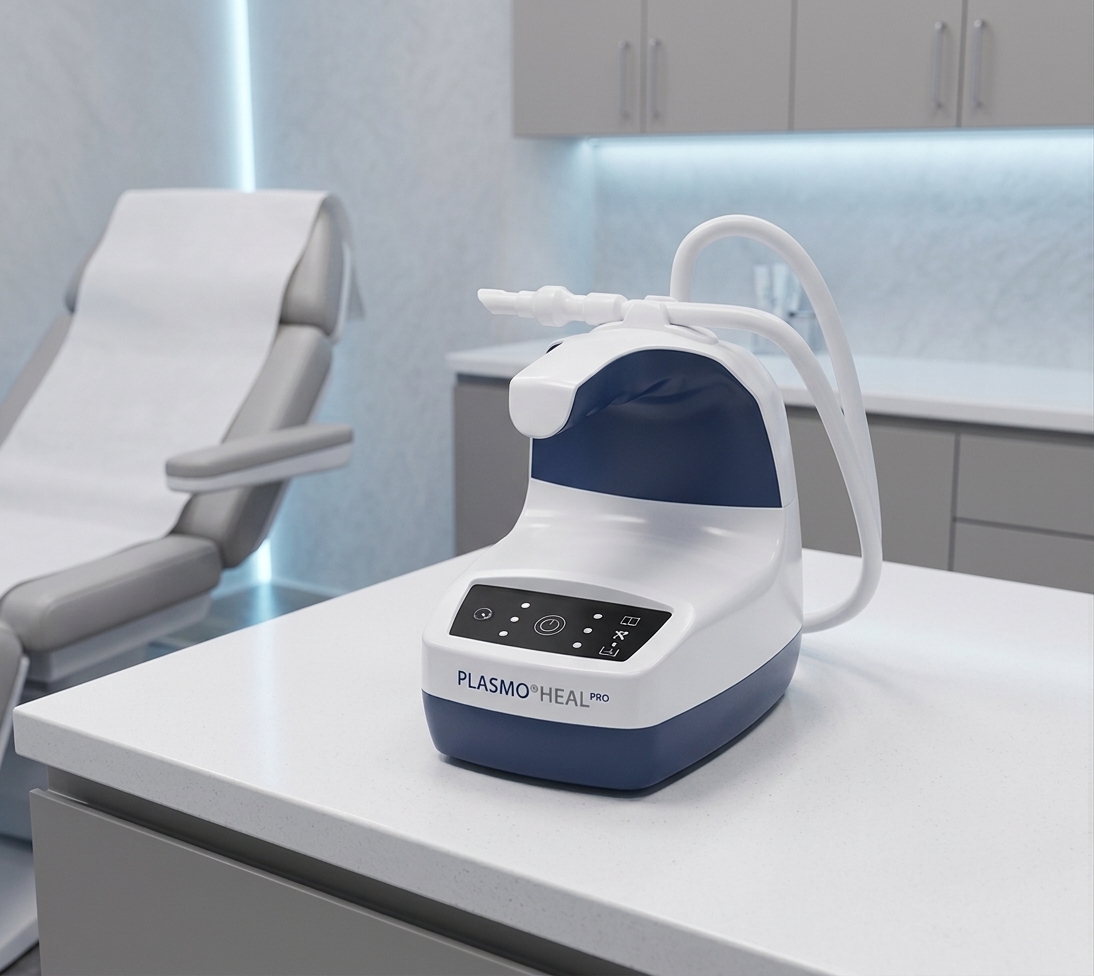
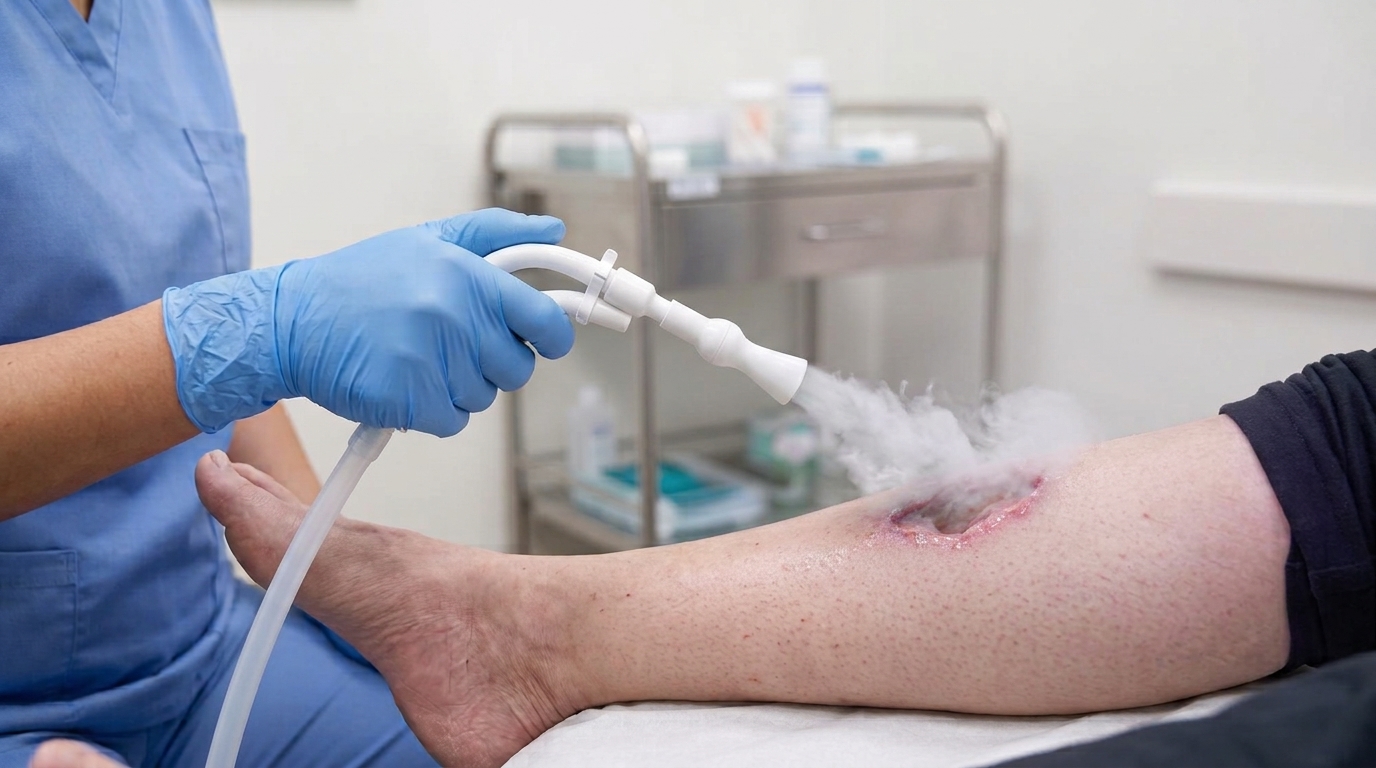
For medical applications with PLASMO®HEAL PRO, an indirect configuration is used: Cold Atmospheric Plasma-Aerosol (CAP-A). The plasma source is located inside the device and conditions the aerosol, which serves as the carrier medium and is subsequently delivered to the treatment area via a tube and applicator. Direct contact between the skin and the plasma source, as well as direct exposure to the cold plasma state itself, is therefore completely avoided.
Distinction from Low-Pressure Plasma.
Industrial low-pressure plasma is generated in gas-tight reaction chambers at significantly reduced air pressure. This technology is well established in semiconductor manufacturing as well as in surface treatment and coating applications. It requires vacuum technology, stationary equipment, and process gases that are not compatible with biological tissue.
Atmospheric plasma differs fundamentally: it operates at atmospheric pressure and does not require pressure control. In clinically relevant forms such as Cold Plasma or Cold Atmospheric Plasma-Aerosol (CAP-A), the gas temperature also remains well below levels that could adversely affect biological tissue. High-temperature atmospheric-pressure plasma variants, such as those used in arc welding, are therefore unsuitable for patient applications.
Temperature Tolerance as a Prerequisite for Patient Use.
Biological tissue can tolerate short-term temperature exposure of up to approximately 42 °C. Medical cold plasma procedures are designed to remain within this reference range. The Cold Atmospheric Plasma-Aerosol (CAP-A) principle underlying PLASMO®HEAL PRO from WK-MedTec GmbH generates an aerosol with a temperature far below 42 °C, according to the product specification.
For clinical application, this means that the aerosol can be applied to wound areas and the surrounding skin without causing thermal stress to the tissue. The intended application is limited to the wound surface and the immediate wound environment; penetration into deeper subcutaneous layers is neither intended nor supported by clinical evidence.
Cold plasma therefore provides the physical basis for a class of devices that can be operated without a pressurized gas supply, vacuum technology, or a dedicated process-gas connection, facilitating integration into routine care in hospitals, medical practices, and outpatient care services.