How Wound-Healing Disorders develop—and what Cold Plasma can do.
A minor skin injury usually heals through a clearly structured biological process. Hemostasis, the inflammatory response, the formation of new tissue and, finally, skin regeneration work together. But what happens when this natural process stalls? An initially limited injury can develop into a chronic wound. Several factors often play a part at the same time: increased microbial burden, persistent inflammation, impaired circulation, oxygen deficiency and metabolic disorders. This complex interplay is what makes impaired wound healing a medical challenge. One increasingly researched approach is cold plasma (Cold Atmospheric Plasma, CAP). Scientific studies show that cold plasma has antimicrobial properties and can also influence processes relevant to wound healing. One development of conventional cold-plasma methods is Cold Atmospheric Plasma-Aerosol (CAP-A). Cold plasma and aerosol are combined to create Cold Atmospheric Plasma-Aerosol, an approach that brings together the properties of cold plasma and wound-irrigation solution in aerosol form.
Wound healing is a highly complex process.
Immediately after an injury, the body begins repairing the damaged tissue. In simplified terms, wound healing can be divided into several interconnected phases:
Hemostasis → Inflammatory phase → Proliferation and granulation → Remodelling.
First, bleeding is stopped. The body then activates a controlled inflammatory response. Immune cells clear away damaged tissue and microorganisms. Next, granulation tissue forms, new blood vessels develop and cells migrate into the wound area. Finally, the newly formed tissue is remodelled and stabilized. Under normal conditions, these phases progress from one to the next in a controlled way. In a chronic wound, however, this process can be interrupted.
When a wound gets “stuck” during healing phase.
Wound-healing disorders are often not caused by a single trigger. Rather, an unfavourable combination of local and systemic factors can prevent a wound from moving from the inflammatory phase into the later stages of regeneration. Possible contributing factors include:
- increased microbial burden,
- biofilms and local infections,
- a persistent inflammatory response,
- impaired circulation,
- inadequate oxygen supply,
- diabetes mellitus and other metabolic disorders,
- mechanical stress,
- excessive exudate production.
This makes one thing clear: a wound is more than an open area in the tissue. It is a highly active biological system, and its surrounding environment can have a significant influence on how healing progresses.
The wound environment as a key factor.
The so-called wound environment is therefore of particular interest. It includes factors such as microbial status, pH, exudate, oxygen supply, and the activity of various cells and inflammatory mediators. Clinical, multicentered, and randomized studies of chronic wounds therefore use different assessment criteria when investigating the effects of new technologies such as cold plasma. Studies compare wound-area reduction, granulation tissue, wound pH, infection status and/or tolerability before and after a new technology is used. In summary, the development of a chronic wound is not considered in isolation; the entire wound environment matters. [1]
What is cold plasma?
Cold plasma is a physical plasma generated at atmospheric pressure and comparatively low temperatures. It contains, among other things, Reactive Oxygen Species (ROS) and molecules that can interact with biological structures. Two important characteristics of cold plasma are its antimicrobial effect and its ability to be tolerated by tissue. Depending on the plasma source and application parameters, microorganisms on surfaces can be affected or reduced. Another aspect is relevant to medical applications. Cold plasma is not studied solely for its antimicrobial properties. Scientific research also examines its effects on cellular processes, the proliferation of healthy tissue cells (fibroblasts), and the wound environment more generally. This suggests a potentially interesting mechanism combining antimicrobial effects with support for wound healing.
Clinical studies of cold plasma.
The clinical evidence needs to be considered carefully. An early systematic review and meta-analysis found no statistically significant benefit of atmospheric low-temperature plasma in reducing microbial burden or wound area. At the same time, its use was considered safe. The review highlighted substantial heterogeneity among the plasma sources and application parameters studied. Different plasma sources could only be compared to a limited extent. [2] More recent clinical data show positive results for applications of cold plasma. [1] [3] Systems differ, for example, in their plasma source, gas, energy input, distance from the surface and treatment duration. As a result, findings from one system cannot automatically be applied to cold plasma as a general category. Reviews have specifically drawn attention to this heterogeneity. [2] Compared with best-practice wound care, evidence suggests that cold plasma treatment can lead to greater granulation-tissue formation and faster wound-area reduction in chronic wounds. Local infections may also resolve sooner, and wound pH may change more quickly. [1] In diabetic foot ulcers, a significantly greater reduction in wound area and faster healing have been observed. No serious treatment-related adverse events were reported. [3] Cold plasma should be considered as part of an overall wound-care plan, not as a replacement for established measures. Taken together, the more recent studies chiefly show that the effects of cold plasma must always be considered in relation to the specific plasma system, its physical parameters and the clinical context in which it is used.
This is where the development of Cold Atmospheric Plasma-Aerosol (CAP-A) comes in. CAP-A is an advancement of conventional cold-plasma methods. Cold plasma and aerosol are combined to create CAP-A. The focus is not solely on generating cold plasma. Instead, the plasma technology is combined with wound-irrigation solution in aerosol form to allow targeted application over a broad area of the wound surface. The aim is also to make use of the beneficial properties of both cold plasma and aerosolized wound-irrigation solution. CAP-A is designed to reduce the microbial burden on the treated surface. Current scientific research also examines possible effects on biological processes relevant to tissue regeneration.
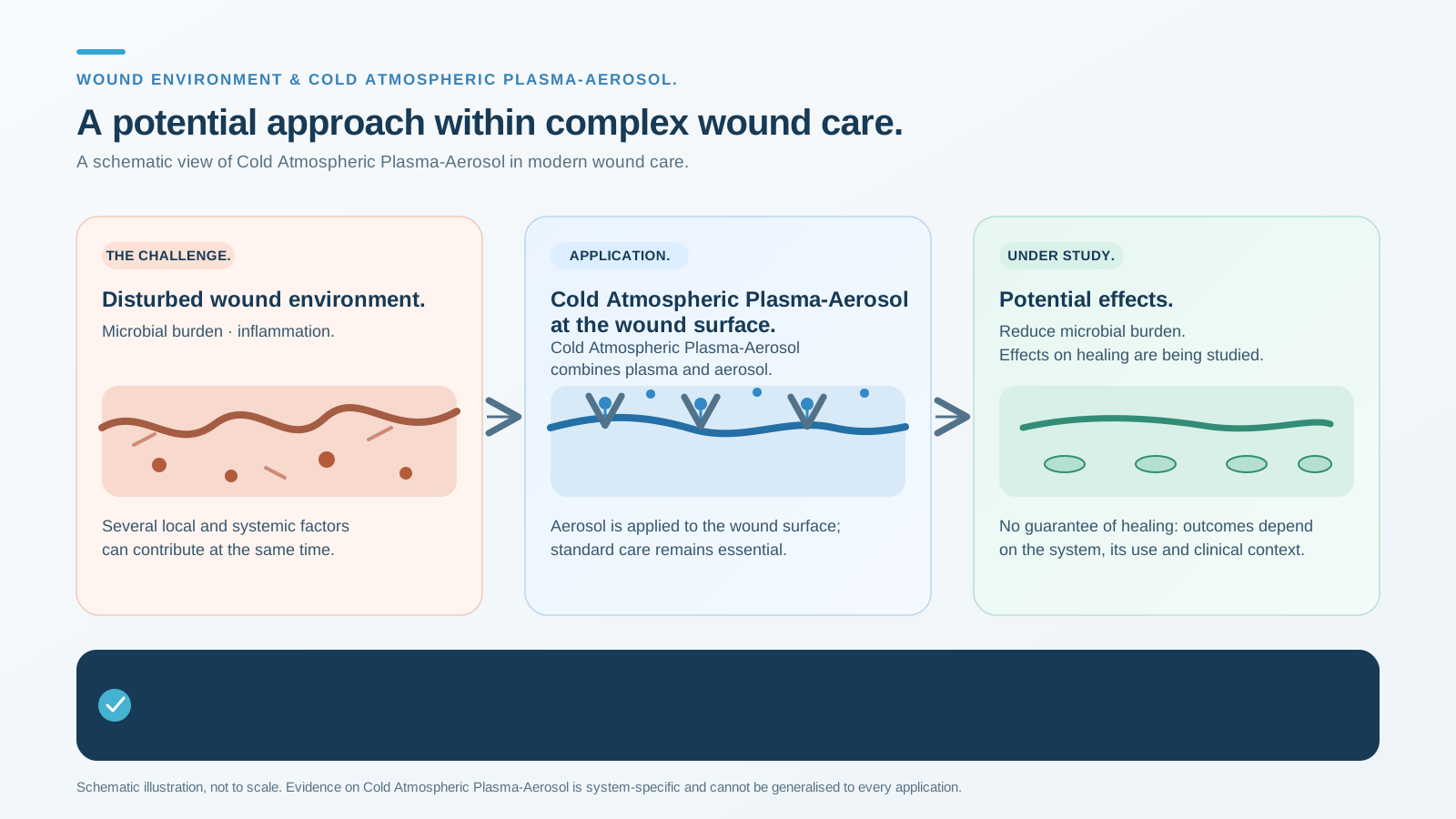
Wound-healing disorders are multifactorial.
The question “How do wound-healing disorders develop?” cannot be answered by pointing to a single factor. A chronic wound can develop when several unfavorable factors combine and the natural wound-healing process is persistently impaired. For example, increased microbial burden, inflammation and impaired circulation can interact. Modern wound care therefore addresses several factors at once: the cause of the wound must be treated, the wound cared for appropriately, and the wound environment made as favorable as possible for regeneration.
Cold plasma as part of an evolving therapeutic approach.
In recent years, cold plasma has become an increasing focus of scientific and clinical research. Existing studies show interesting antimicrobial and wound-healing-related effects. At the same time, the evidence is not entirely consistent because of differences in plasma sources, study protocols and application parameters. The ongoing developments are what makes the field interesting. Cold Atmospheric Plasma-Aerosol offers an approach that combines the properties of cold plasma and aerosol. The aim is to influence the wound environment through the physical properties of both plasma and aerosol. The future will depend in particular on better technical and clinical characterization of the different technologies, a clearer understanding of their mechanisms of action, and suitable clinical studies of their respective applications. It is already well established, however, that complex wound-healing disorders require more than one measure for appropriate care.
The intended purpose and use of a specific product are determined by its authorization. Decisions about human and veterinary treatments should be made in consultation with the healthcare professional responsible and independently of this article. This article does not make any claims about healing or treatment. The effects mentioned refer to studies conducted under evaluated, standardized conditions. This overview of current research about Cold Atmospheric Plasma-Aerosol (CAP-A) is for informational purposes only and describes independent scientific findings.
[1] https://www.nature.com/articles/s41598-022-07333-x
Chronic wounds treated with cold atmospheric plasmajet versus best practice wound dressings: a multicenter, randomized, non-inferiority trial. Scientific Reports.
[2] https://onlinelibrary.wiley.com/doi/full/10.1111/iwj.12999
Effects and safety of atmospheric low-temperature plasma on bacterial reduction in chronic wounds and wound size reduction: A systematic review and meta-analysis. International Wound Journal.
[3] https://jamanetwork.com/journals/jamanetworkopen/fullarticle/2768340
Effect of Cold Atmospheric Plasma Therapy vs Standard Therapy Placebo on Wound Healing in Patients With Diabetic Foot Ulcers: A Randomized Clinical Trial. JAMA Network Open.
.png)