Cold Atmospheric Plasma-Aerosol in modern Wound Care. Integrating a new Treatment Step.
Modern wound care is developing increasingly towards standardised, biologically active treatment concepts that reduce the microbiological burden and specifically support regenerative processes. Cold Atmospheric Plasma-Aerosol (CAP-A) plays a central role here. On the basis of current scientific findings, the technology is increasingly being discussed as an integral component of structured wound treatment workflows. A new second treatment step following initial wound cleansing is on the horizon. As a medical device, PLASMO®HEAL PRO is based on this new technology and is used for wounds, infection, inflammation and infection prophylaxis.
Cold plasma in modern wound care.
Cold Atmospheric Plasma (CAP) denotes a partially ionised gas at close to room temperature that contains a broad spectrum of Reactive Oxygen Species (ROS), charged particles as well as electromagnetic and ultraviolet radiation. These components act synergistically on microbiological structures and biological tissue processes. [1]
In clinical use, cold plasma is employed in various forms of application, among them direct Cold Atmospheric Plasma (CAP) as well as the further development of the aerosol-based system, Cold Atmospheric Plasma-Aerosol (CAP-A). Here, cold plasma and aerosol fuse. The technology is intended to enable more even treatment over larger areas. The aim is not only to reduce the microbial burden, but also to exert a positive influence on cellular processes such as tissue regeneration.
Typical fields of application in modern wound medicine include in particular:
- chronic wounds (e.g. ulcus cruris, diabetic foot ulcer).
- infected or critically colonised wounds.
- postoperative wound healing disorders.
- wounds with impaired microcirculation.
Wound therapy today increasingly follows structured algorithms. Conventionally it comprises cleansing, debridement, antiseptic measures and modern wound dressings. In this context, cold plasma-based methods are understood as a complementary physical form of therapy that follows on directly from the initial wound preparation.
The effects of integration into modern wound care.
The scientific evidence for cold plasma in wound treatment is well documented, particularly in the field of chronic wounds. Clinical studies show a significant improvement in the reduction of microbial burden as well as in microcirculatory parameters after application. An increase in deep capillary perfusion and improved tissue oxygenation, for example, have been demonstrated. [2] Overall, these effects lead to an accelerated reorganisation of the wound healing phases, particularly in the proliferation phase. [3]
In the context of Cold Atmospheric Plasma-Aerosol it is additionally discussed that aerosol-based application may allow improved penetration into complex wound geometries. This is of particular importance in deep, irregularly contoured or exudative wounds, in which conventional forms of application can be limited. Against the background of the current evidence, Cold Atmospheric Plasma and Cold Atmospheric Plasma-Aerosol are increasingly regarded no longer as an additive option but as a structurally integrated component of modern wound care workflows.
How cold plasma aerosol can be meaningfully integrated.
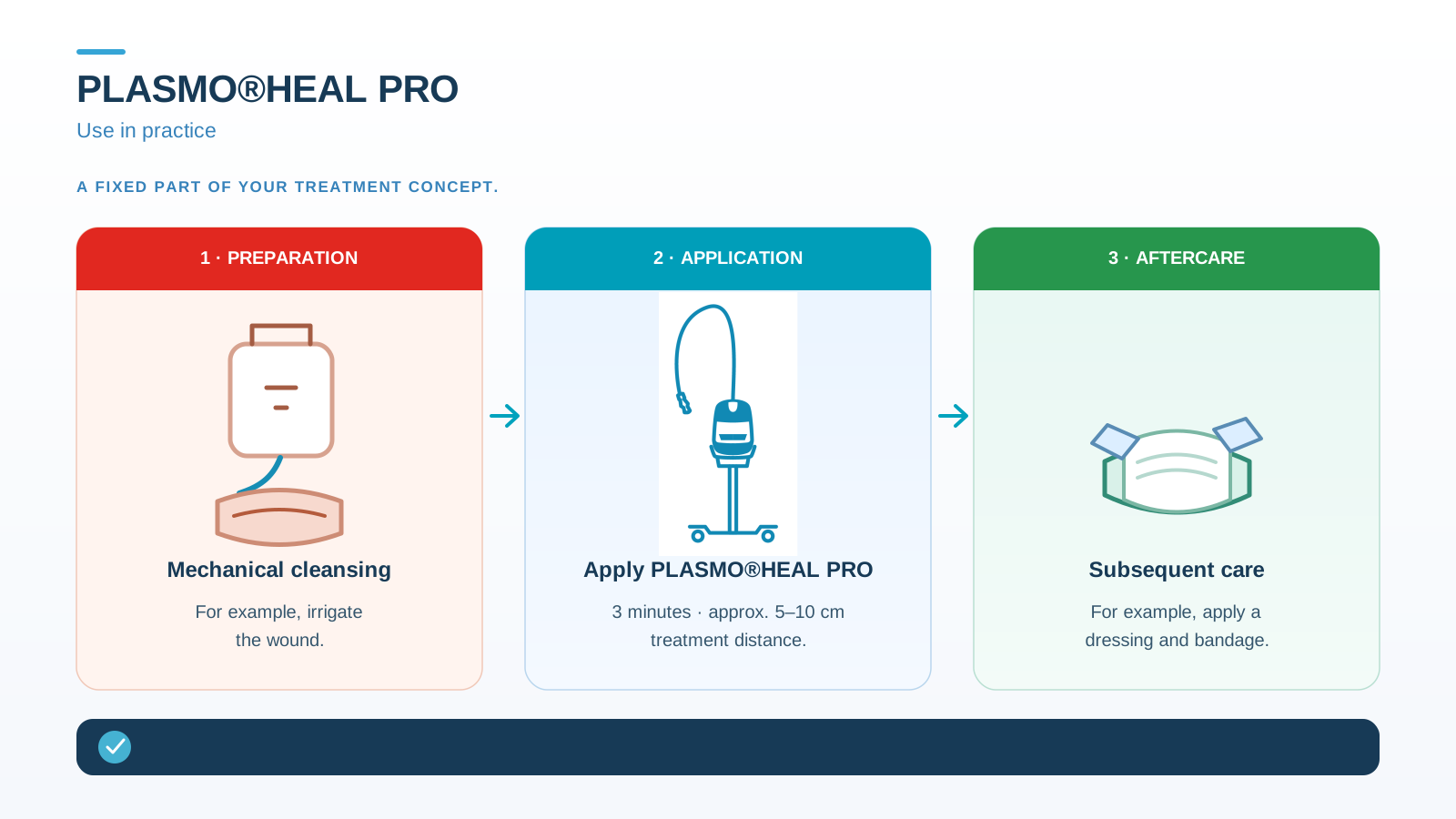
The integration of Cold Atmospheric Plasma-Aerosol into existing wound care workflows follows a clear therapeutic principle: after the initial mechanical and antiseptic wound preparation, the technology constitutes a standardised second step that addresses the biological activation of the wound environment. The fine particles literally settle on the treatment area. This positioning promises a combination of microbiological efficacy and improved microcirculation. The remaining wound care then follows.
In future, Cold Atmospheric Plasma-Aerosol can be expected to be integrated more strongly into guideline-oriented treatment pathways, particularly in the field of chronic and therapy-resistant wounds. In parallel, the further refinement of application parameters (dose, time, frequency, spacing systems) will be decisive in ensuring reproducible clinical efficacy.
Overall, this second treatment step is proving to be a technologically and biologically promising building block of a modern, multimodal wound therapy, one that is increasingly understood as an established component of structured treatment concepts.
The intended purpose and use of a specific product are determined by its approval. Human and veterinary therapies are to be decided independently of this article, in consultation with the responsible medical professionals. This article does not constitute a claim of cure or therapy. The effects described relate to studies under verified, standardised conditions. This overview page on current research with Cold Atmospheric Plasma-Aerosol (CAP-A) serves information purposes only and presents independent scientific findings.
[1] https://onlinelibrary.wiley.com/doi/10.1155/2019/3873928
Plasma Medicine: Applications of Cold Atmospheric Pressure Plasma in Dermatology. Oxidative Medicine and Cellular Longevity.
[2] https://onlinelibrary.wiley.com/doi/10.1111/micc.12754
A single application of cold atmospheric plasma (CAP) improves blood flow parameters in chronic wounds. Microcirculation.
[3] https://journals.bioscientifica.com/rem/article/2024/1/e230026/26324/Cold-atmospheric-plasma-CAP-in-wound-healing
Cold atmospheric plasma (CAP) in wound healing: harnessing a dual-edged sword. Redox Exp Med.