Aerosols in Medicine. How the finest Particles deliver active Substances precisely where they are needed.
When people hear the term aerosol, they often think of the finest liquid droplets in the air. That idea is understandable, but scientifically it falls short.
Aerosols are not just droplets. A widespread misconception.
An aerosol is fundamentally a system of solid and/or liquid particles distributed in a gas, usually air. Aerosols therefore encompass far more than mist or sprays. Dust, smoke and pollen are aerosols, too. What matters is not the physical state of the particles, but their ability to remain suspended in the air for a certain period of time. The rule is: dust is an aerosol, but not every aerosol is dust. Dust consists exclusively of solid particles, whereas aerosols can contain both solid and liquid components. This distinction is also relevant to medicine. While nebulizers mostly produce liquid droplets of an active substance, dry powder inhalers release solid particles of it. Both systems work with aerosols and pursue the same goal: to transport active substances into the airways as efficiently as possible.
Why aerosols are so interesting for medicine.
The airways offer a unique route into the body. The lungs have an enormous surface area and, at the same time, an excellent blood supply. As a result, active substances can not only act directly in the airways but, under certain conditions, also reach the bloodstream quickly. It is precisely these properties that make aerosols an ideal vehicle for medicines. Instead of taking the detour via the stomach, the intestine or an injection, the active substance can reach its target site directly. This means the effect sets in faster and, in most cases, a smaller amount of the active substance is sufficient. The main fields of application for medical aerosols are:
- Asthma and COPD (Chronic Obstructive Pulmonary Disease).
The best-known applications are found in the treatment of bronchial asthma and chronic obstructive pulmonary disease. Bronchodilators and anti-inflammatory agents are delivered directly into the airways, where they can take effect quickly. - Cystic fibrosis and chronic lung infections.
In cystic fibrosis and other chronic lung diseases, aerosols are used to deliver antibiotics or mucolytic agents specifically to the lungs. This makes it possible to achieve high local concentrations without placing an unnecessary burden on the entire organism. - Inhaled vaccines.
A particularly exciting field of research is inhalable vaccines. Since many pathogens enter the body via the airways, immunisation directly at the mucous membranes could offer additional protection. Aerosol therapies are considered very safe. Nevertheless, side effects are possible, for example short-term irritation of the mucous membranes, coughing or hoarseness. With certain inhaled corticosteroids, fungal infections in the mouth can occur. Hygiene aspects also play a role. Nebulisers must be cleaned regularly to prevent colonisation by microorganisms. [1] [2]
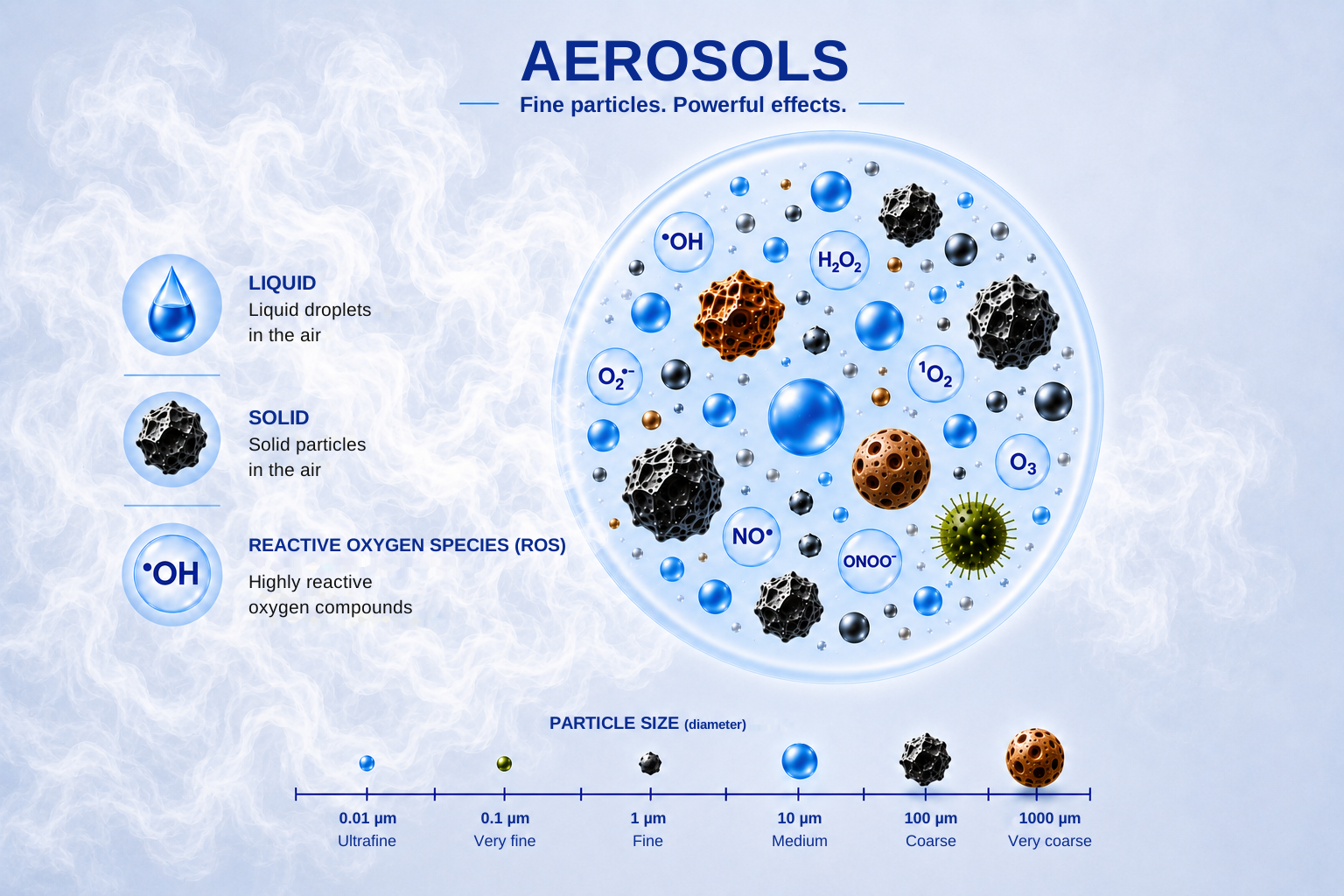
A promising future for aerosol research. Cold Atmospheric Plasma-Aerosol as the union of cold plasma and aerosol.
For a long time, aerosols were associated above all with asthma and COPD. Today, aerosol medicine is developing into one of the most dynamic areas of modern drug delivery. New particle technologies, nanocarriers, inhalable biologics and innovative vaccine platforms are continuously expanding the therapeutic possibilities. The vision is clear: active substances should reach their destination more precisely, more quickly and with fewer side effects. Particular attention is currently being paid to a still young field of research at the interface between aerosol medicine and physical plasma medicine. Here, aerosols are treated with physical plasma, which makes it possible to introduce short- and long-lived Reactive Oxygen Species into the aerosol. This gives rise to what are known as plasma-treated aerosols, which combine the biomedical effects of physical plasma with the established advantages of aerosol application, such as its physical detachment and displacement effect. [3]
Initial preclinical investigations indicate that this approach could open up new possibilities for the local treatment of infections and chronic inflammation. The field of research is still at a very early stage of development, and numerous questions regarding efficacy, dosage and long-term safety have yet to be clarified. The current results nevertheless show remarkable potential. Should the approach be confirmed in preclinical and clinical studies, plasma-treated aerosols could in future establish a new class of therapeutic applications within aerosol medicine.
Aerosols are far more than fine droplets in the air. Their ability to deliver active substances precisely into the airways makes them an indispensable tool of modern medicine. From asthma and COPD through antibiotic therapies to future vaccines, biologics and plasma-treated aerosols, the potential of this technology is becoming clear. What is already an established standard in airway therapy today could tomorrow be an entirely new and promising treatment method.
The intended purpose and application of a specific product are determined by its approval. Human and veterinary therapies are to be decided independently of this article, in consultation with the responsible medical professionals. This article does not constitute a healing or therapeutic claim. The effects mentioned refer to studies conducted under verified, standardised conditions. This overview page on current research into Cold Atmospheric Plasma-Aerosol (CAP-A) is provided for information purposes only and explains independent scientific findings.
[1] https://doi.org/10.1046/j.1365-2125.2003.01892.x
Pulmonary drug delivery. Part I: Physiological factors affecting therapeutic effectiveness of aerosolized medications. British Journal of Clinical Pharmacology.
[2] https://doi.org/10.1517/17425247.2013.790362
Aerosol delivery to intubated patients. Expert Opinion on Drug Delivery.
[3] https://doi.org/10.1002/ppap.202400275
Short Review on Plasma–Aerosol Interactions. Plasma Processes and Polymers.